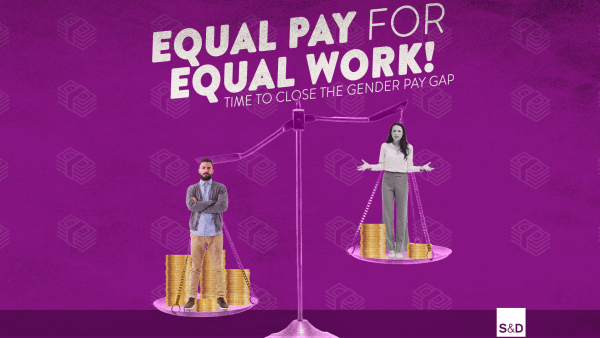

The Socialists and Democrats in the European Parliament express disappointment with the European Commission’s newly adopted Gender Equality Strategy 2026–2030. At a time when gender equality is increasingly under pressure from far-right extremists across Europe and beyond, the S&D Group expected to see a stronger and more forward-looking agenda from the Commission. While the strategy places an important focus on implementing recently adopted legislation, it contains limited new legislative initiatives to further advance women’s rights and gender equality in the EU.
The implementation of recently agreed directives is essential, but the S&D Group believes the European Union must also take new decisive steps to address persistent inequalities, gender-based violence and growing anti-gender movements.
Marko Vešligaj, European Parliament's negotiator on the matter in the EP's committee on women's rights and gender equality, said:
“While we welcome the Commission’s commitment to fully implement the important legislation adopted in recent years, this strategy falls short of the ambition Europe needs. At a time when women’s rights are increasingly challenged and anti-gender narratives are gaining ground, simply relying on existing tools is not enough.
“On gender-based violence, the focus on combating online violence against women and girls and strengthening enforcement tools through the Digital Services Act is important. However, the Commission’s approach remains too cautious. The commitment to review the landscape following the Violence Against Women Directive and to consider further action to ensure that sex without consent is recognised as rape across the EU is a step in the right direction – but it is far too weak. European women deserve clear and binding protections everywhere in the Union.
“We do welcome several positive elements in the strategy. The Commission’s firm commitment to implementing the Pay Transparency Directive is crucial for finally addressing the gender pay gap, and we strongly support the announcement of a comprehensive European care deal in 2027, including investments in care services. These measures can make a real difference in women’s economic independence. The possibility of new legislation on sexual harassment in the workplace is also an important signal.
“At the same time, the strategy acknowledges a worrying trend: the spread of anti-gender narratives, illegal online content, and their artificial amplification, which increasingly threaten our democratic space and fuel polarisation between young women and men. The Commission’s plans to study online networks and narratives targeting young men and boys, as well as to strengthen engagement with civil society and organise discussions on misogyny and incel ideology, are necessary steps. But research and dialogue alone will not be enough. We also need stronger political action to tackle the root causes of these movements and defend equality as a core European value.
“Europe must remain a global leader on gender equality. For that, we need courage, new legislative initiatives, and a clear political commitment to move forward – not just to maintain what has already been achieved.”